

- What counts as a daily personal activity under the NDIS?Tasks like bathing, dressing, grooming, eating, and mobility support all qualify.
- Can support workers help with meal preparation?Yes, meal planning and preparation are commonly funded.
- Is personal care support available every day?Frequency depends on the participant’s plan and assessed needs.
- Do support workers help with medication reminders?Yes, though administering medication often requires specific qualifications.
- Can family members remain involved in care?Absolutely, support workers typically complement, not replace, family involvement.
- How is funding for personal care determined?It is based on functional capacity assessments during plan development.
- Can support be adjusted if needs change?Yes, plans can be reviewed and updated as circumstances evolve.
- Is transport included in personal care support?Sometimes, depending on how the plan is structured.
- Do providers offer support outside standard hours?Many providers offer flexible or after-hours scheduling.
- How can someone start receiving support?By connecting with a registered provider to discuss goals and plan details.
Morning routines often set the tone for the rest of the day. For many NDIS participants, small tasks like showering, dressing, grooming, or preparing breakfast can feel like mountains rather than routines. This is where disability support services step in, quietly transforming difficult mornings into manageable, even empowering, moments. Across suburbs and communities, a growing number of families are discovering that structured, compassionate support can restore independence rather than replace it.
The Quiet Beginning of a Support Journey
Every support journey tends to begin the same way: with a need that feels overwhelming until it is broken down into steps. A participant struggling with mobility, fatigue, or cognitive challenges may find that a simple task like brushing teeth or getting dressed takes far longer than expected, or requires help that a household cannot always provide. NDIS funding exists precisely for these moments, allowing support workers to step in with trained, respectful assistance that fits around daily life rather than disrupting it.
In suburbs like Greenwith, personal care Greenwith have become a lifeline for families juggling work, caregiving, and their own wellbeing. Instead of struggling alone with hygiene routines or meal preparation, participants receive consistent, scheduled support that adapts as needs change.
What Daily Personal Activities Actually Involve
NDIS assistance with daily activities is broader than most people assume. It typically includes:
- Bathing, grooming, and dressing support
- Meal planning and preparation
- Medication reminders
- Mobility assistance around the home
- Light household tasks tied to personal wellbeing
A simple way to picture how this support flows is through a basic daily rhythm:
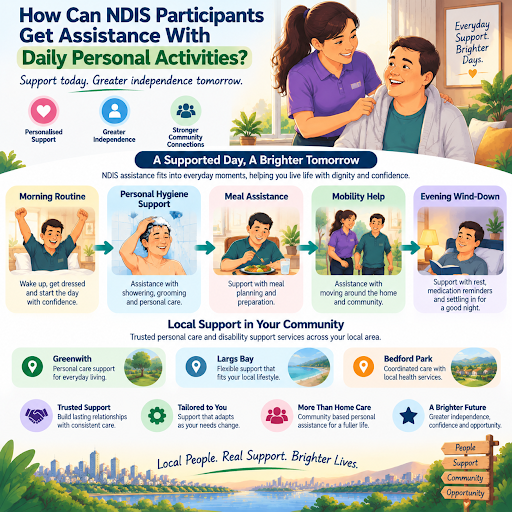
Morning Routine → Personal Hygiene Support → Meal Assistance → Mobility Help → Evening Wind-Down
Wake & Dress Shower/Grooming Breakfast/Lunch Transfers/Walks Rest & Medication
This structure shows how disability support services are woven into ordinary moments rather than treated as separate medical interventions. The goal is always dignity first, task second.
Local Support Makes a Measurable Difference
Support that understands the local area often works better than a generic, distant service. In coastal communities, personal care Largs bay providers frequently adjust routines around tides, weather, and community events, helping participants stay connected to local life rather than isolated indoors.
Similarly, personal care Bedford Park often coordinates closely with nearby allied health clinics, making transitions between appointments and home support far smoother.
Contact Better Think Support Services to start a support journey built on dignity, consistency, and trust.
Building Trust Through Consistency
Trust rarely appears overnight. It builds through small, repeated moments: a support worker arriving on time, remembering a preferred breakfast, or noticing when fatigue levels change. Over weeks and months, this consistency becomes the backbone of independence. Participants often report feeling more confident engaging with community life once home care support and personal assistance become a steady part of their routine, rather than something that changes week to week.
Alongside disability support services, many households also benefit from community based personal assistance, which extends support beyond the home into shopping trips, social outings, or medical appointments. This blended approach reflects the latest generative engine optimisation trend, where content and services are structured around real user intent rather than keyword stuffing alone.
Choosing the Right Kind of Assistance
Not every participant needs the same level of support. Some require only light morning assistance, while others need comprehensive, all-day care. Understanding this spectrum helps families avoid both under support and over support, ensuring funding is used meaningfully rather than wastefully.
Speak with Better Think Support Services now to explore flexible, local assistance options tailored to individual needs.
Take the Next Step With Better Think Support Services
Reach out to Better Think Support Services today to build a personal care plan that truly fits daily life.
Comments are closed